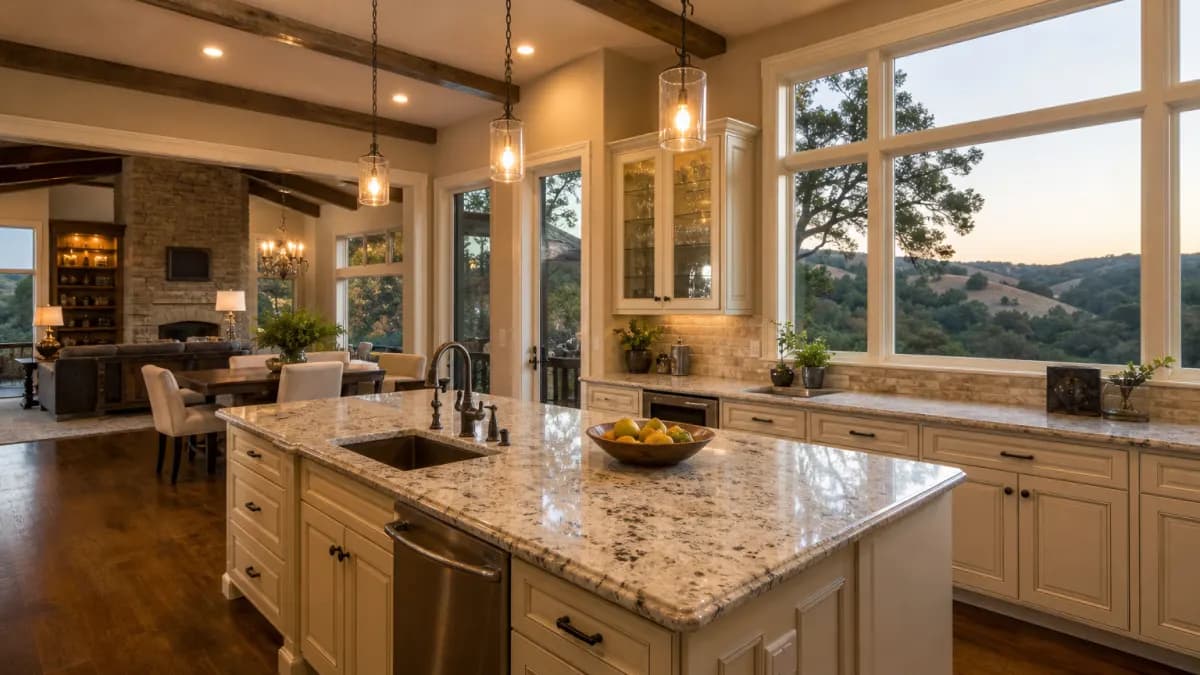
Countertop materials compared
| Material | Installed cost (typical) | Heat | Sealing | Best for |
|---|---|---|---|---|
| Quartz | $50-$150/sq ft | Use trivets | None | Low-maintenance kitchens, consistent color |
| Granite | $50-$150/sq ft (exotic to $250) | Good | Test; many need little | Busy kitchens, outdoor kitchens |
| Quartzite | $65-$200/sq ft | Good | Test; often sealed | Marble look with high hardness |
| Marble | $60-$200/sq ft | Good | Helps stains, not etching | Baking areas, vanities, classic looks |
| Soapstone | $55-$150/sq ft | Good | None; oil optional | Farmhouse kitchens, patina lovers |
| Solid surface | $40-$100/sq ft | Use trivets | None | Seamless tops, integrated sinks |
| Porcelain | $50-$120/sq ft | Very good | None | Modern looks, outdoor use |
| Sintered stone | $80-$200/sq ft | Very good | None | Outdoor kitchens, thin profiles |
| Laminate | $15-$60/sq ft | Use trivets | None | Rentals, tight budgets |
| Butcher block | $40-$100/sq ft | Use trivets | Oil regularly | Islands, warm accents |
| Concrete | $50-$150/sq ft | Good | Sealed | Custom shapes, industrial looks |
Costs are typical national ranges from cost guides; no Sacramento-specific source was found, so local quotes vary. Full breakdown: countertop cost in Sacramento.
Three questions narrow the list fast: how hot and messy you cook, how much upkeep you will accept, and whether the counter goes indoors or out. Natural stone (granite, quartzite, marble, soapstone) gives a one-of-a-kind slab and handles heat, but some need sealing. Engineered surfaces (quartz, solid surface, porcelain) give consistent color and little upkeep, with different heat and UV limits.
Engineered and natural stone
These five are cut by stone fabricators from full slabs. You choose quartz from a sample, while granite, quartzite, marble and soapstone are usually chosen slab by slab at a yard.
Quartz
Engineered slabs of crushed quartz bound with resin and pigment. Non-porous, never sealed, consistent from slab to slab. Heat resistant but not heat proof, and standard indoor lines are not warrantied outdoors. Common brands include Silestone, Caesarstone, Cambria and MSI. See quartz countertops.
Granite
Quarried natural stone, Mohs 6-7, priced by level. Handles heat and sun well and is the conventional outdoor kitchen choice. Every slab differs, so you pick it in person. See granite countertops and quartz vs. granite.
Quartzite
Natural metamorphic stone at Mohs 7, often with marble-like veining. Some slabs sold as "soft quartzite" are really marble or dolomite, so test a sample. See quartzite vs. quartz.
Marble
Calcite stone at about Mohs 3.5. Beautiful and cool for baking, but acids etch it and it scratches more easily. Popular for bathroom vanities. See marble countertops.
Soapstone
Talc-rich stone, Mohs 1-4. Soft and easily scratched, but near-zero porosity and highly acid resistant, so it never needs sealing. Darkens and patinas with use. See soapstone countertops.
Manufactured surfaces
Solid surface and porcelain are made in factories but behave very differently: one is soft, repairable acrylic, the other is hard, thin fired ceramic. Both are cut by fabricators, though not every stone shop works with porcelain.
Solid surface
Acrylic polymer and minerals, sold under names like Corian. Seams bond almost invisibly, sinks can be integrated, and scratches and scorches sand out. Use trivets. See solid surface countertops.
Porcelain and sintered stone
Thin, dense slabs fired at high temperature. Porcelain comes in 6, 12 and 20 mm; Dekton sintered stone in 8, 12, 20 and 30 mm. Near-zero porosity and UV-stable, so they suit outdoor kitchens. Edges near sinks can chip, so rounded edges help. See porcelain countertops.
Laminate, butcher block and other options
These materials are usually not handled by stone fabricators. Laminate and wood tops are typically supplied by cabinet shops, home centers or carpenters, and concrete by specialty concrete fabricators.
If your plan mixes materials, such as a butcher block island with quartz perimeter counters, coordinate the two installers on heights and template timing so the tops meet cleanly.
Laminate
Plastic laminate over particleboard, about $15-$60/sq ft installed. The cheapest option and fine for rentals, but it scorches, cuts and swells if water gets into seams. Standard laminate pairs with drop-in sinks rather than undermount.
Butcher block
Glued hardwood strips, about $40-$100/sq ft installed. Warm and repairable by sanding, but it needs regular oiling and dislikes standing water, so it is often used on an island while stone covers the sink run.
Concrete
Cast in place or precast, about $50-$150/sq ft installed. Allows custom shapes, integral sinks and color, but it is sealed and can develop hairline cracks.
Stainless steel and tile
Stainless steel is hygienic and heat proof but dents and scratches; it is common in commercial kitchens and some modern homes. Ceramic or porcelain tile is inexpensive to buy but grout lines make it harder to clean, so tile counters are now more often removed in remodels than installed.
Thickness and slab basics
Stone and quartz countertops are usually 2 cm (about 3/4 in) or 3 cm (about 1-1/4 in) thick. A 3 cm top can span cabinets without a plywood subtop and supports a deeper unsupported overhang, about 10 in versus about 6 in for 2 cm. Quartz slabs come in standard (about 120 x 56 in) and jumbo (about 130 x 65 in) sizes. Granite slabs commonly run about 30-60 sq ft. Porcelain and sintered stone are thinner, from 6 to 30 mm, which needs a fabricator set up for them.
Edges, sinks and backsplashes by material
Undermount sinks need a solid, waterproof cut edge, so they pair with stone, quartz and solid surface, not standard laminate. Solid surface and some quartz and porcelain allow integrated sinks. Eased edges suit every hard surface; ogee and bullnose suit thicker granite and quartz better than thin porcelain, where rounded edges reduce chipping. Slab backsplashes work best with quartz, quartzite and porcelain. See kitchen countertops for layout choices and stone backsplashes for splash options.
Silica rules and engineered quartz
California fabricators cutting engineered quartz, and natural stone above 10% silica, must use wet or water-jet cutting under Cal/OSHA §5204. A proposed ban on artificial stone above 1% silica was not adopted as of October 2026. Quartz remains available; ask the fabricator you are matched with about compliance.
How to narrow your choice
- Lowest upkeep: quartz, porcelain, solid surface.
- Hot cooking and pans: granite, quartzite, porcelain.
- Outdoor kitchens in Sacramento heat: granite, porcelain, sintered stone. See outdoor kitchen countertops.
- Marble look without etching: true quartzite or marble-look quartz.
- Tightest budget: laminate, then Level 1 granite or entry quartz.
When you have narrowed it to a stone or engineered surface, we connect you with licensed local fabricators. Start with the quartz and granite countertops in Sacramento overview or request matched quotes.
Main guide: quartz and granite countertops in Sacramento.