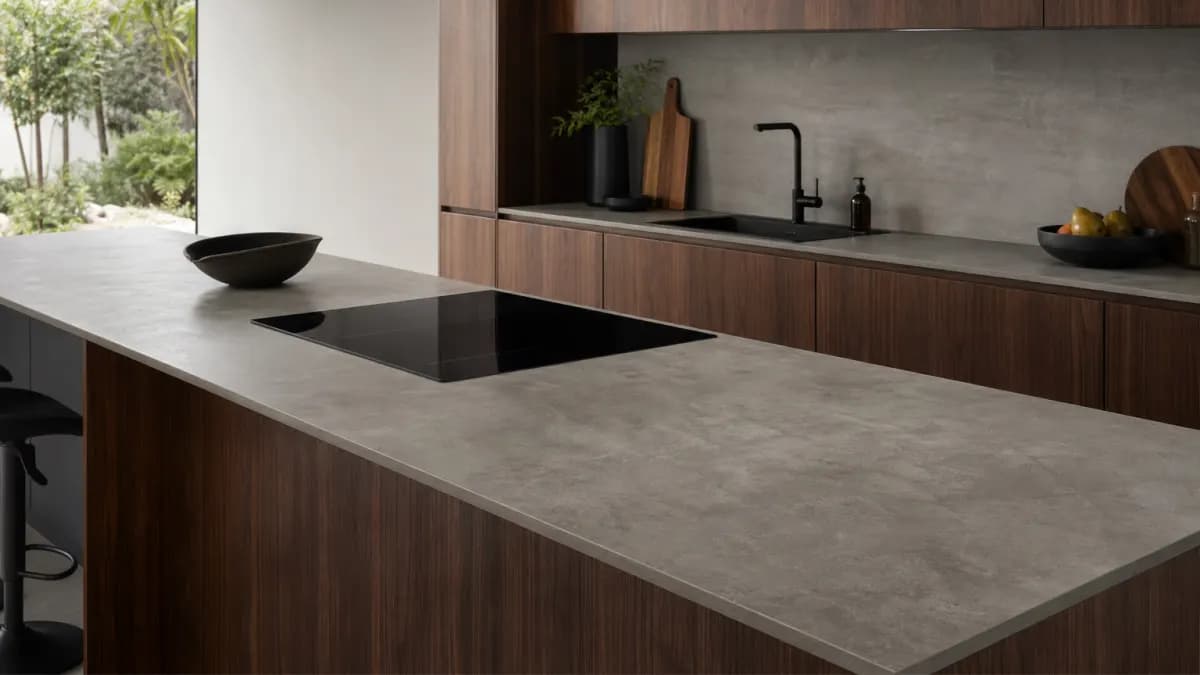
What porcelain and sintered stone are
Porcelain countertops are large, thin slabs made from refined clays and minerals pressed and fired at high temperature, the same family as porcelain tile but in panels big enough to cover a counter. Sintered stone, sold under names such as Dekton (Cosentino) and Neolith, is made from a similar mineral mix compacted and fired so the particles fuse without resin. Caesarstone also sells a porcelain line. The look is printed or built into the slab, which is how manufacturers produce convincing concrete, marble and metal finishes.
Because there is no resin binder, porcelain and sintered stone behave differently from engineered quartz in heat and sun. Our sources do not publish a single Mohs value for these products, so compare them by manufacturer specifications rather than a hardness number.
Thickness and slab format
| Product family | Published thicknesses |
|---|---|
| Caesarstone porcelain | 6 mm, 12 mm, 20 mm (20 mm in select colors) |
| Dekton sintered stone | 8 mm, 12 mm, 20 mm, 30 mm |
| Quartz and granite (for comparison) | 2 cm (about 3/4 in) or 3 cm (about 1-1/4 in) |
Thin slabs (6–12 mm) are common for wall cladding, backsplashes and furniture, and on countertops they are usually installed over a full substrate with a mitered front edge built up to look thicker. 20 mm and 30 mm slabs are closer to a conventional stone countertop. Ask which thickness the fabricator recommends for your layout, and how overhangs will be supported; the manufacturer's own guidance governs here, not natural stone rules of thumb.
Porcelain countertop cost
Typical national ranges from published cost guides; local quotes vary with the product line, thickness and how much mitering the design needs.
| Item | Typical national range |
|---|---|
| Porcelain, installed | $50–$120/sq ft |
| Sintered stone (Dekton-type), installed | $80–$200/sq ft |
| Quartz, installed (for comparison) | $50–$150/sq ft |
| Edge upgrade beyond eased | $10–$40/linear ft |
| Waterfall end | $500–$2,000 per end |
| Backsplash installation | $500–$1,500 (full-height slab usually higher) |
Mitered edges and waterfall ends are common with porcelain, and they add labor. A fabricator who cuts porcelain often will usually price more predictably than a shop that mainly does granite. For whole-kitchen math, see countertop cost in Sacramento.
How porcelain performs in Sacramento
Sun and outdoor kitchens
Cosentino states that Dekton is unaffected by ultraviolet rays and does not fade indoors or outdoors, and Caesarstone describes its porcelain as UV-resistant and suited to outdoor use. With a July normal high near 94°F and about 20+ days a year at 100°F or hotter, that matters for a backyard kitchen. Porcelain is one of the few non-granite surfaces manufacturers position for outdoor counters. See outdoor kitchen countertops.
Heat
Cosentino describes Dekton as resistant to extreme temperatures and fire. In practice porcelain handles hot cookware far better than engineered quartz or solid surface. A trivet is still sensible for pans dragged across the surface, since a hard pan base can scratch or chip a thin edge.
Stains, hard water and acids
Porosity is near zero, so wine, oil and coffee do not soak in, and porcelain does not need sealing. Hard water spots wipe off with a damp cloth and a mild cleaner. Unlike marble, porcelain is not etched by lemon or vinegar.
Chipping: the weak spot
Cosentino notes that chips usually happen near undermount sinks and the dishwasher area, and recommends rounding edges to minimize chipping; chips can be repaired. Some porcelain slabs have a printed surface pattern that does not continue through the body, so a chip or a profiled edge can show a different color underneath. Ask whether your product is through-body before choosing an edge.
Edges, sinks and finishes
Most porcelain kitchens use a mitered edge (two pieces joined at 45°) to create a clean, thick-looking front, or a slightly eased square edge. Decorative profiles such as ogee generally do not suit thin, printed slabs. Undermount sinks are common, but the cutout edge is the most chip-prone spot, so a small radius there helps. Finishes range from matte and textured to high gloss. See countertop edge profiles for more.
California silica rules and porcelain
Cal/OSHA's Title 8 §5204 sets dust-control rules for cutting artificial stone and natural stone above 10% silica: a constant flow of water, submerged cutting or water-jet cutting, plus respirators and monitoring. Its definition of artificial stone ends with this line: "Fired ceramic and porcelain tiles and panels are not artificial stone." Whether a given large-format porcelain or sintered product falls under that exclusion is a product-by-product question for the fabricator. Either way, a careful shop cuts porcelain wet, and asking how they control dust is a reasonable question for any countertop job.
Questions to ask a porcelain fabricator
- How many porcelain or sintered stone kitchens have you fabricated, and can I see one?
- Is this product through-body color, or a printed surface? What will the mitered edge and sink cutout look like?
- What thickness do you recommend for my layout, and how will overhangs be supported?
- How do you control dust when cutting, and do any cuts happen at my house?
- Are the mitered edges and waterfall ends included in the per-square-foot price, or quoted separately?
Clear answers to these questions matter more with porcelain than with granite, because thin slabs leave less room for fabrication mistakes. For backsplash and wall cladding ideas using the same slab, see stone backsplashes.
Care
- Daily: warm water and mild soap or a non-abrasive cleaner.
- No sealing needed.
- Use cutting boards; the hard surface dulls knife blades quickly.
- Protect edges near the sink and dishwasher from impacts with heavy pots.
Who porcelain suits, and who should skip it
Porcelain suits outdoor kitchens, sunny west-facing kitchens, modern and minimal designs, and anyone who wants concrete or marble looks without porosity or etching. It also suits full-height backsplashes and island cladding, since thin panels are light.
Skip it, or compare carefully, if you want decorative edge profiles, if your household is hard on edges, or if no fabricator near you has strong porcelain experience. Granite and quartz remain the mainstream choices; our guide to quartz and granite countertops in Sacramento covers them.
Main guide: quartz and granite countertops in Sacramento.