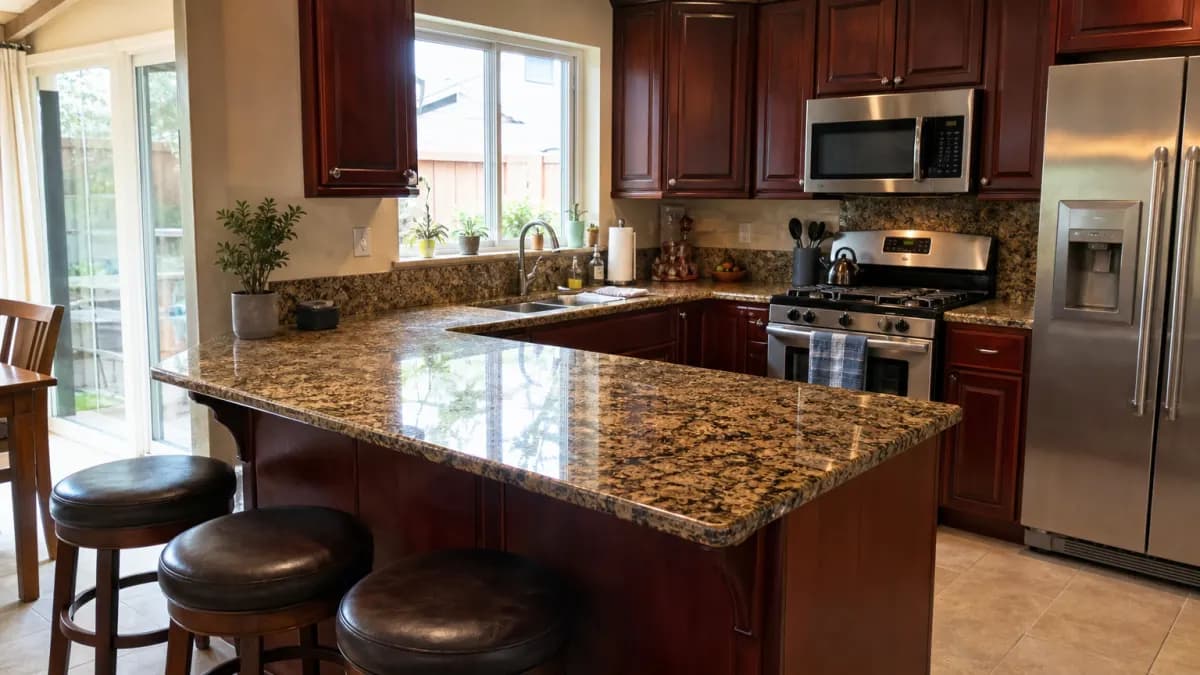
What granite is
Granite is an igneous rock quarried in blocks and sawn into slabs. It is a mix of minerals, mainly feldspar and quartz, which is why most granites show speckles or flecks rather than long veins. The Natural Stone Institute puts granite at 6–7 on the Mohs hardness scale, hard enough that everyday knives and pans rarely mark it. Granite is also a loose trade name: some slabs sold as granite are other igneous or metamorphic stones with similar properties.
Every slab is different. Two slabs of the same name from different blocks can vary in background color, movement and the size of the mineral grains, so the slab you see at the yard is the one that matters, not the sample in a showroom binder.
Granite levels and cost per square foot
Distributors group granite into levels (sometimes called grades A through F). The level reflects rarity, origin and demand, not quality or durability. These are typical national ranges; local quotes vary.
| Level | Typical installed cost | What you usually see |
|---|---|---|
| Level 1 (grade A) | $50–$80/sq ft | Common speckled colors in tan, brown, black and gray |
| Level 2 (grade B) | $80–$150/sq ft | More movement, lighter backgrounds, less common colors |
| Level 3+ (exotic, C–F) | $150–$250/sq ft | Dramatic veining, rare colors, imported specialty stone |
A typical granite kitchen of about 30–40 sq ft lands around $2,400–$6,000 installed in national guides. Add-ons follow the same pattern as other stone: edge upgrades at $10–$40 per linear ft, a cooktop cutout at $100–$200, removal of the old top at $50–$300+, and a waterfall island end at $500–$2,000. See countertop cost in Sacramento for full-kitchen math across materials.
How granite performs in a Sacramento kitchen
Heat and sun
Granite has no resin to scorch, so it handles hot cookware better than engineered quartz. Trivets are still a good habit, because a sudden hot spot on a cold slab or near a seam is not worth the risk. Granite is also the conventional choice for outdoor kitchen countertops in a climate with a July normal high near 94°F and about 20+ days a year over 100°F. If the counter sits in full afternoon sun, ask the fabricator how a dark versus light slab will feel in August, and consider a shade structure.
Staining, hard water and acids
Most granites are dense, and the Natural Stone Institute notes that staining is rare with routine cleaning. Lighter, more porous slabs can darken if oil or wine sits overnight. White mineral rings from hard water wipe off with a damp cloth and a stone-safe cleaner; avoid vinegar-based home remedies, which can dull some stones and break down sealer. Granite does not etch from lemon juice the way marble does.
Slab sizes, thickness and overhangs
| Spec | Typical figure |
|---|---|
| Slab size | About 6–10 ft long by 5–6 ft wide (30–60 sq ft); varies by quarry |
| 2 cm thickness | About 3/4 in; usually needs a plywood subtop or built-up edge |
| 3 cm thickness | About 1-1/4 in; the common kitchen thickness |
| Max unsupported overhang, 3 cm | 10 in, never more than 1/3 of the top's width |
| Max unsupported overhang, 2 cm | 6 in |
The overhang figures come from the Natural Stone Institute's design guidance. A bar-height seating overhang deeper than 10 in needs corbels, brackets or concealed steel supports. Because granite slabs vary in size, ask the fabricator to lay out your template on the actual slabs so you know where seams and the best part of the pattern will land.
Finishes and edges
Polished is the standard granite finish and brings out the color. Honed and leathered finishes are matte and show fewer smudges and water spots, but they can absorb more readily, so sealing matters more. An eased edge is typically included. Bevel and half or full bullnose usually run $10–$15 per linear ft, ogee $20–$25, and dupont $20–$40. Compare them on our countertop edge profiles page.
Sealing and care
Not every granite needs sealing. Use the Natural Stone Institute's water test: put a little water on the stone, leave it 10–15 minutes, wipe it and let it air-dry. If the spot darkened, the stone absorbs water and is a candidate for sealing. The NSI says a quality sealer can last 10–15 years; rather than resealing on a fixed calendar, repeat the water test now and then and reseal when water starts to darken the stone.
- Daily: warm water and a pH-neutral stone cleaner or mild dish soap.
- Wipe oil, wine and coffee the same day, especially on light slabs.
- Skip vinegar, bleach and abrasive powders.
Step-by-step instructions are in granite sealing and countertop care.
Sinks, cooktops and backsplashes with granite
Granite is solid and waterproof at the cut edge, so it pairs well with an undermount sink: the cutout edge is polished and crumbs wipe straight into the bowl. A farmhouse (apron-front) sink also works but needs a base cabinet built for it, which matters if you are keeping existing cabinets. Top-mount sinks work too and are the simplest swap when the old sink is staying.
| Item | Typical national range |
|---|---|
| Sink cutout | $0–$300 (first cutout often included) |
| Cooktop cutout | $100–$200 |
| Backsplash installation | $500–$1,500 (full-height slab usually higher) |
| Plumbing reconnect | $45–$200/hr |
A 4 in. granite splash cut from the same slab is the traditional look. A full-height slab backsplash behind the range shows off a dramatic Level 2 or Level 3 stone but uses more material. From template to install, expect about 1–3 weeks; the install itself usually takes about a day for a typical kitchen.
Who granite suits, and who should skip it
Granite suits heavy cooks, outdoor kitchens, foothill homes with warm wood cabinets, and anyone who wants natural stone at a price that starts lower than quartzite or marble. Level 1 granite is often the lowest-cost natural stone option for a full kitchen.
Skip it if you want a uniform, all-white look with no speckle, or if you dislike the idea of ever testing and sealing a counter. Engineered quartz is the usual alternative; see quartz vs. granite.
Buying tips for granite
- Visit the slab yard and photograph the actual slabs, front and back, with the lot or bundle number.
- Ask the yard to tag the slabs to your name so the fabricator cuts those exact pieces.
- Look for fissures and pits under a raking light; natural fissures are normal, cracks through the slab are not.
- Do the water test on a sample of your slab before deciding about sealing.
- Confirm the fabricator's shop follows Cal/OSHA §5204 wet-cutting rules, which cover natural stone above 10% silica as well as quartz.
For a broader comparison of materials, start with our guide to quartz and granite countertops in Sacramento.
Main guide: quartz and granite countertops in Sacramento.