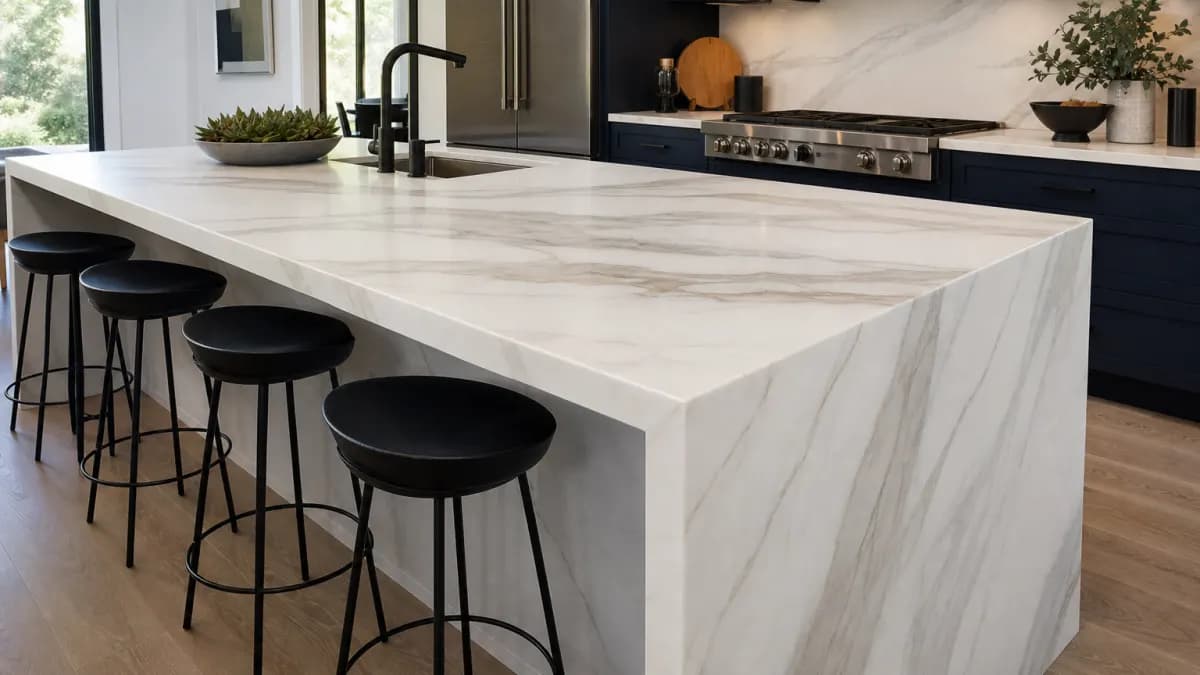
What quartzite is, and what it is not
Quartzite is a natural metamorphic rock: sandstone that heat and pressure fused into a dense mass of quartz grains. It is quarried and sawn into slabs like granite. The Natural Stone Institute rates quartzite at 7 on the Mohs scale, harder than granite (6–7) and roughly twice as hard as marble (about 3.5).
It is not the same as engineered quartz. Quartz countertops are manufactured from crushed quartz and resin; quartzite is solid rock with no binder. The names confuse a lot of shoppers, so our quartzite vs. quartz guide lays out the differences side by side.
The "soft quartzite" problem
The Natural Stone Institute calls "soft quartzite" a fictional label. In most cases a slab sold that way is really marble or dolomite, which etches from acids and scratches more easily. Mislabeling is the main risk in buying quartzite, and it is why testing the actual slab matters.
How to test a quartzite slab before you buy
Ask the yard for an offcut or a remnant from the same bundle, or permission to test an inconspicuous spot. Two quick checks come straight from Natural Stone Institute guidance:
- Glass scratch test. Drag a sharp corner of the stone firmly across a glass tile or bottle. Granite and true quartzite scratch glass. Marble, dolomitic marble, limestone, travertine, onyx, soapstone and serpentine do not.
- Acid etch test. Put a few drops of lemon juice or vinegar on a polished area, wait several minutes, wipe, and look at it at an angle. True quartzite does not etch. If a dull spot appears, the stone contains calcite or dolomite and is mislabeled. Dolomite etches more slowly than marble, so give it time.
A slab that fails either test may still be beautiful. Just price and care for it as marble or dolomite, not as quartzite.
Quartzite countertop cost
Quartzite costs more than most granite partly because the stone is slower to cut and polish. These are typical national ranges from cost guides; local quotes vary.
| Item | Typical national range |
|---|---|
| Quartzite, installed | $65–$200/sq ft |
| Granite, installed (for comparison) | $50–$150/sq ft (exotic to $250) |
| Quartz, installed (for comparison) | $50–$150/sq ft (premium to $200) |
| Waterfall end | $500–$2,000 per end |
| Edge upgrade beyond eased | $10–$40/linear ft |
White and light quartzites with soft veining, including the widely requested Taj Mahal, tend to sit in the middle to upper part of the range. Bold, colorful or rare quartzites go higher. Waterfall islands use extra material and need careful vein matching, so expect the slab count, not just the square footage, to drive the quote. For full-kitchen estimates, see countertop cost in Sacramento.
How quartzite performs in a Sacramento kitchen
Heat and sun
Quartzite has no resin, so it tolerates hot cookware and direct sun better than engineered quartz. That makes it a strong pick for a bright kitchen with big west-facing windows. Use trivets anyway; any stone can crack from a sharp temperature shock near a seam or cutout.
Etching, staining and hard water
True quartzite resists lemon, wine and vinegar etching, which is the main reason people pick it over marble. It is still natural stone with some porosity, and lighter slabs can absorb oil if it sits. Run the water test (10–15 minutes, wipe, let dry; a dark spot means it absorbs) and seal if needed. Hard water spots wipe off with a damp microfiber cloth and a stone-safe cleaner.
Slabs, thickness and fabrication
Quartzite slabs come in sizes set by the quarry block, so there is no single standard size. Ask how many slabs your layout needs and whether the island can come from one piece. Thickness follows the usual stone pattern: 2 cm (about 3/4 in) or 3 cm (about 1-1/4 in). Natural Stone Institute guidance limits unsupported overhangs to 10 in for 3 cm stone and 6 in for 2 cm, never more than 1/3 of the top's width.
Quartzite is hard on tooling, and some slabs are brittle along veins, so it rewards a fabricator who cuts it regularly. Ask to see a finished quartzite job and how they plan seams on your layout. Because quartzite is natural stone with high silica content, the shop's cutting must follow Cal/OSHA §5204 wet-method rules too.
Finishes and edges
Polished finishes show the most depth in the veining. Honed and leathered finishes look softer and hide fingerprints, but they can absorb a little more, so check the water test on the finish you choose. An eased edge is typically included; for islands, a mitered edge makes a 3 cm slab read as a thick block and pairs naturally with a waterfall end. See countertop edge profiles.
Care
- Daily: warm water and a pH-neutral stone cleaner.
- Water test once in a while; reseal when water darkens the stone.
- Trivets under hot pans; cutting boards for knives.
- No abrasive powders, which can dull a polished finish.
Timeline from slab to install
- Choose and tag your slabs at the yard, after testing an offcut.
- The fabricator templates once base cabinets are installed and level, with a laser or physical templates.
- The shop cuts and polishes the stone using wet methods or water-jet, as Cal/OSHA §5204 requires.
- Install day, typically about one day for a kitchen.
- A plumber reconnects the sink and faucet, sometimes on a later day.
- The stone is sealed if the water test shows it absorbs.
Expect about 1–3 weeks from template to install. Waterfall islands and book-matched seams can take longer because the fabricator has to plan the vein layout across several pieces. In California, the down payment on a home improvement contract is capped at $1,000 or 10% of the contract price, whichever is less, so a large deposit request for slabs is a red flag. Our countertop fabrication process guide walks through each step.
Who quartzite suits, and who should skip it
Quartzite suits homeowners who love the look of marble but cook a lot, families with kids who will spill juice, and anyone who wants natural stone that handles heat and sun. It is a common island choice paired with a quieter quartz or granite perimeter.
Skip it if budget is tight (Level 1 granite or entry quartz costs less), if you want perfectly uniform color, or if you are not willing to visit the yard and test the slab. For an overview of every option, see our guide to quartz, granite and quartzite countertops in Sacramento.
Main guide: quartz and granite countertops in Sacramento.