The short answer: natural stone vs. engineered slab
Quartzite is a natural metamorphic rock. Sandstone rich in quartz is fused by heat and pressure into a dense stone, quarried in blocks and cut into slabs like granite. Taj Mahal quartzite, with its warm taupe veining on a cream background, is the name Sacramento buyers search for most.
Quartz countertops are engineered. Crushed quartz, up to about 90% of the slab by Caesarstone's description, is bound with resin and pigment and pressed into slabs. Silestone, Caesarstone, Cambria and MSI are brands homeowners commonly compare.
| Factor | Quartzite | Engineered quartz |
|---|---|---|
| Origin | Quarried natural stone | Factory-made from quartz, resin and pigment |
| Hardness | Mohs 7 | No single published value for the slab |
| Heat | Natural stone, no resin to scorch | Heat resistant, not heat proof; use trivets |
| Porosity | Varies by slab; test and seal if it absorbs | Non-porous; never sealed |
| Pattern | Every slab unique; choose in person | Consistent; sample matches the install |
| Outdoor use | Natural stone tolerates sun | Standard indoor lines not warrantied outdoors |
| Installed cost | $65-$200/sq ft | $50-$150/sq ft, premium to $200 |
Where each one has the edge
Where quartzite wins
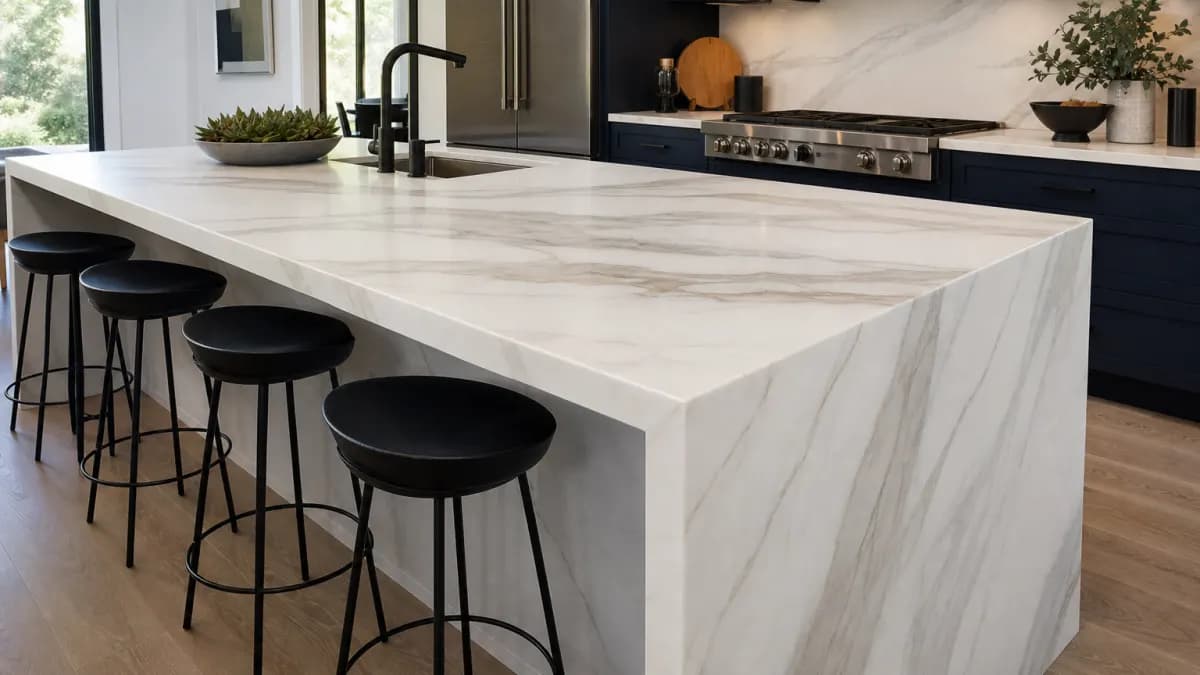
True quartzite rates Mohs 7, harder than granite at 6-7 and far harder than marble at about 3.5. It does not etch from lemon juice or vinegar. It has no resin, so a hot pan will not leave the kind of scorch mark that can happen on engineered quartz. That makes it the usual pick for homeowners who want the look of marble with much better wear, and for waterfall islands where the veining wraps down the side. See quartzite countertops for common varieties.
Where quartz wins
Quartz needs no sealing, costs less at the entry level, and looks the same on the sample as on the counter. You can order it from a catalog without a trip to the slab yard. For a rental, a busy family kitchen or a bathroom vanity where you want zero upkeep, quartz is often the simpler choice. See quartz countertops.
Which to choose
- Choose quartzite if you want natural stone, cook with hot pans, want a waterfall with real veining, or plan an outdoor kitchen.
- Choose quartz if you want no sealing, a predictable pattern, a lower entry price, or a sample-matched order.
- Choose neither if the "quartzite" fails the acid test and you were not planning for marble care.
Still deciding between natural options? Compare quartz vs. granite too.
The "soft quartzite" problem
Some slabs are sold as quartzite that are really marble or dolomite. The Natural Stone Institute calls "soft quartzite" a fictional label and says that in most cases the stone is actually marble or dolomite. Those stones look similar but are softer and react to acids, so a buyer expecting quartzite performance gets etching instead.
The glass scratch test
Ask the yard for an offcut or sample of the exact material. Drag a sharp corner firmly across a glass tile or bottle. Granite and true quartzite scratch glass. Marble, dolomitic marble, limestone, travertine, onyx, soapstone and serpentine do not. Wipe away any powder and feel for a groove; a streak of stone dust is not a scratch.
The acid etch test
Put a few drops of lemon juice or vinegar on a polished sample and leave it several minutes. True quartzite will not etch. Calcite stones like marble will lose their shine in that spot, and dolomite etches more slowly. If a stone sold as quartzite etches, it is mislabeled. Do this on a sample, not on an installed counter.
What to do if it fails
A dolomite or marble slab can still make a beautiful countertop, but price and care should match what it is. Read marble countertops for how etching and staining differ, then decide with accurate expectations.
Choosing a slab at the yard
- Ask the yard for the stone's origin and how they classify it, then run the glass scratch and acid tests on a sample of the same lot.
- Look at the full slab under daylight if you can. Quartzite veining often shifts across a slab, and a 3 cm slab can weigh several hundred pounds, so book a viewing rather than flipping slabs yourself.
- Photograph the tag number and the area you want on the island or waterfall.
- For quartz, order a sample of the exact color and finish (polished, honed or textured) and view it in your kitchen light.
- Confirm thickness: both come in 2 cm and 3 cm. Most kitchens use 3 cm.
Quartz slabs come in standard (about 120 x 56 in) and jumbo (about 130 x 65 in) sizes, and every slab of a color matches. Quartzite slab sizes vary by quarry, so a long island may need a seam or a second slab. Ask the fabricator to lay out the template on photos of the actual slabs before cutting.
Cost: quartzite usually runs higher
Typical national installed ranges put quartzite at $65-$200/sq ft and quartz at $50-$150/sq ft, with premium quartz near $200. Quartzite is hard to cut and polish, and slab-to-slab variation means more care with layout, which shows up in fabrication cost. No Sacramento-specific price source was found, so treat these as national ranges and compare local quotes.
| Example | Quartz | Quartzite |
|---|---|---|
| 40 sq ft kitchen, surface only | $2,000-$6,000 | $2,600-$8,000 |
| Waterfall end (each) | $500-$2,000 | $500-$2,000 |
Waterfall pricing is per end and depends on vein matching. More on totals in countertop cost in Sacramento.
Sealing and care
Quartz is never sealed. Clean it with mild soap and water and keep hot pans on trivets. Quartzite absorbency varies by slab. Do the water test: leave water on the surface 10-15 minutes, wipe, and let it dry. A dark spot means the stone absorbs liquid and should be sealed with a quality sealer. Retest periodically and reseal when water starts darkening the stone again. Full routines are in granite sealing and countertop care.
Silica rules apply to both
Cal/OSHA §5204 covers fabrication of engineered stone above 0.1% crystalline silica and natural stone above 10%. Quartzite is very high in silica, so shops cutting it fall under the same wet-cutting, respirator and monitoring rules as quartz shops. A proposed California ban on artificial stone above 1% silica was in rulemaking but not adopted as of October 2026; the proposal is aimed at artificial stone, not natural quartzite.
We connect you with licensed local fabricators who work in both materials. Start on the quartz and granite countertops in Sacramento overview or ask for matched quotes.
Main guide: quartz and granite countertops in Sacramento.