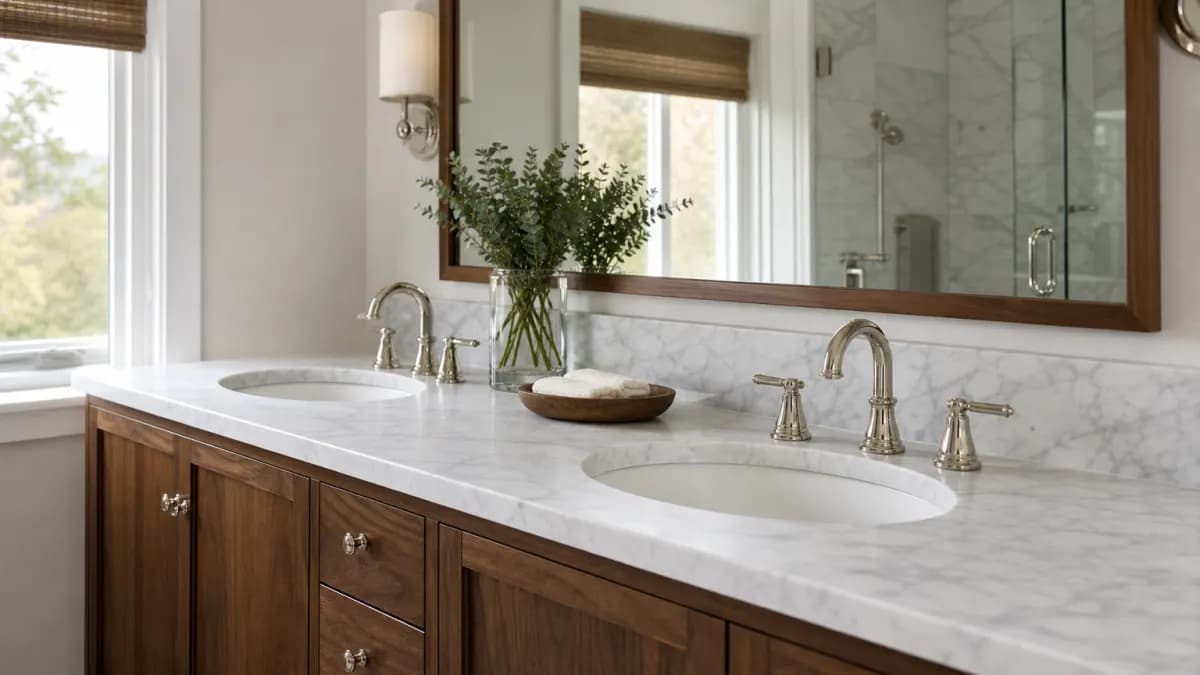
What marble is
Marble is metamorphic limestone: calcite (calcium carbonate) recrystallized under heat and pressure. The Natural Stone Institute puts it at about 3.5 on the Mohs scale, compared with 6–7 for granite and 7 for quartzite. Steel knives, ceramic mug bottoms and grit dragged under a pan can all mark it.
The white Italian marbles carry most of the demand. Carrara is usually light gray with soft, feathery gray veining. Calacatta and Statuario have whiter backgrounds and bolder veins, and they cost more. Dolomitic marbles are a little harder and etch more slowly, which is why some are sold as "soft quartzite"; treat them as marble.
Etching vs. staining
This is the single most important thing to understand before you buy. They look different, have different causes and need different fixes.
| Etch | Stain | |
|---|---|---|
| What it looks like | Lighter, dull, rough-feeling spot | Darker spot in the stone |
| Cause | Acid dissolves a little of the calcite surface | A liquid (oil, wine, coffee) absorbed into the pores |
| Common culprits | Lemon, lime, tomato, wine, cola, vinegar, some cleaners | Cooking oil, red wine, coffee left overnight |
| Does sealer prevent it? | No | Reduces it |
| Fix | Re-honing or polishing by a stone pro | Poultice; often fades with time |
The Natural Stone Institute notes that true staining of marble is relatively rare. Etching is the everyday reality. On a polished finish, etch marks show as dull patches; on a honed finish they blend in much better, which is why honed marble is the usual recommendation for kitchens. Light etches on a honed surface can often be blended with a marble polishing compound or by a stone restoration pro; on polished marble, repairs are more noticeable until the whole area is refinished.
Marble countertop cost
These are typical national ranges; local quotes vary with the specific marble, slab count and fabrication.
| Item | Typical national range |
|---|---|
| Marble, installed | $60–$200/sq ft |
| Single bathroom vanity top, installed | $200–$1,000 (varies by material and size) |
| Edge upgrade beyond eased | $10–$40/linear ft |
| Sink cutout | $0–$300 (first cutout often included) |
| Old top removal | $50–$300+ |
Commercial-grade Carrara sits toward the lower end of the marble range. Calacatta, Statuario and book-matched slabs sit at the top. A vanity is the cheapest way into real marble: a single-sink top uses so little stone that a remnant can sometimes cover it. Compare full-kitchen numbers on countertop cost in Sacramento.
Where marble works in a Sacramento home
Bathroom vanities: the easy yes
Vanities see toothpaste, soap and water, not lemon juice and wine. Marble ages gracefully there, and the cost is modest. See bathroom vanity tops for sink and size options. Keep acidic cleaners and some toothpaste or mouthwash spills wiped promptly; they can etch.
Kitchens: go in with eyes open
A marble kitchen will etch, usually sooner than owners expect, and it develops a patina. Many owners like that look; others find it stressful. Honed marble, a trivet habit and wiping acids quickly keep it presentable. A marble baking station or a single island paired with quartz or granite on the working perimeter is a common compromise.
Heat, sun and hard water
Marble has no resin, so sun will not yellow it and a warm pan will not scorch it, though trivets are still wise. It is generally not used for outdoor kitchens, where citrus, marinades and grill grease etch and stain it. Hard water rings are an issue indoors: do not scrub them off with vinegar, which etches. Use a damp cloth and a pH-neutral stone cleaner.
Slabs, thickness and finishes
Marble slab sizes depend on the quarry block. Thickness follows the usual stone choices of 2 cm (about 3/4 in) and 3 cm (about 1-1/4 in); vanities are often 2 cm with a built-up or mitered edge. Natural Stone Institute guidance limits unsupported overhangs to 6 in for 2 cm and 10 in for 3 cm stone, never more than 1/3 of the width.
Polished marble shows etches most. Honed is the kitchen standard. Edges: eased is typically included, and a softly rounded edge resists chipping better than a sharp corner on a stone this soft. Ogee and dupont suit traditional marble kitchens; see countertop edge profiles.
If you love the look but not the upkeep
Plenty of Sacramento homeowners want a Carrara or Calacatta look in a kitchen that sees daily lemon water and red sauce. Three alternatives come up most often:
| Option | Typical installed range | Trade-off vs. marble |
|---|---|---|
| Marble-look quartz | $50–$150/sq ft | No etching or sealing; not heat proof; veining is designed, not natural |
| Quartzite (tested) | $65–$200/sq ft | Mohs 7, no acid etching; still natural and may need sealing |
| Marble-look porcelain | $50–$120/sq ft | No etching, UV-stable; thin slabs, limited edge profiles |
Many kitchens split the difference: real marble on a baking island or vanity, and quartz countertops or quartzite on the hard-working perimeter. Before committing, live with a sample on your counter for a week. Pour lemon juice on it, leave a wet glass on it, and decide whether the result bothers you.
Caring for marble
- Seal on installation and reseal when the water test shows the stone absorbing again. Sealer reduces stains; it does not prevent etching.
- Clean with pH-neutral stone cleaner. No vinegar, lemon, bleach or bathroom acid cleaners.
- Use coasters under wine glasses and citrus drinks, cutting boards for knives, trivets for pans.
- Have a stone restoration pro re-hone heavy etching every few years if the patina bothers you.
Buying tips
- Ask the yard for a sample and run the acid test yourself: lemon on polished and honed pieces, so you see how etches look on each.
- Choose slabs in person; Carrara varies widely between bundles.
- If a slab is sold as quartzite but etches, price and care for it as marble. See quartzite countertops.
- Agree on the finish in writing. Switching from polished to honed after install costs extra.
- Plan seams on light marble carefully. Veining should flow across a seam, so ask the fabricator to show the layout on photos of your actual slabs.
For a broader comparison of stone and engineered options, start with our guide to quartz and granite countertops in Sacramento.
Main guide: quartz and granite countertops in Sacramento.