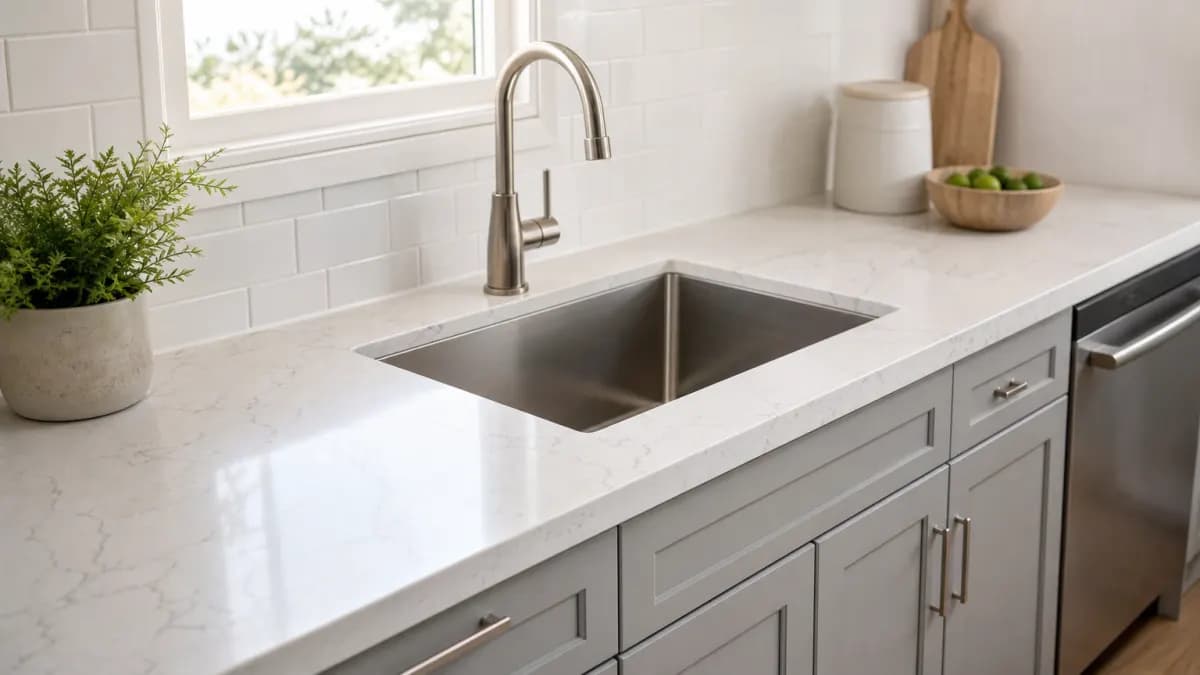
What engineered quartz is
Quartz countertops are an engineered product, not a quarried slab. Manufacturers crush natural quartz, mix the particles with resin and pigment, then press and cure the mix into slabs. Caesarstone describes its product as up to 90% quartz, with the rest pigments and resin. Because the pattern is designed rather than found, two slabs of the same color look nearly identical, which is why quartz is the default for homeowners who want a predictable white, gray or marble-look surface.
Quartz the mineral rates 7 on the Mohs hardness scale. Finished engineered slabs have no single published Mohs value, so treat any brochure number with care. In daily use quartz resists scratches from cutlery and pans well, and its resin binder makes it non-porous, so it does not need sealing.
Brands homeowners ask about
Silestone (Cosentino), Caesarstone, Cambria and MSI's Q Premium line are the names most Sacramento shoppers bring to a quote. Fabricators in our network can typically source several brands through local distributors. Warranty terms differ by brand: Silestone, for example, publishes a 25-year residential warranty. Read the specific warranty for the color you pick, because it usually covers indoor use only.
How quartz performs in a Sacramento kitchen
Heat
Quartz is heat resistant, not heat proof. Caesarstone states that the resin can only withstand roughly 150 degrees before it can scorch or discolor. A pan straight off a burner, a slow cooker left running for hours, or an air fryer venting onto the surface can leave a permanent mark. Keep trivets near the range and under countertop appliances.
Sun and outdoor use
Sacramento's normal July high is about 94°F, with about 20+ days a year at 100°F or hotter. Standard indoor quartz is not warrantied outdoors: both the Silestone residential warranty and the Caesarstone indoor warranty exclude outdoor installs. For a patio kitchen, look at a product the manufacturer rates for outdoor use, such as Caesarstone's Outdoor collection, or at outdoor kitchen countertops in granite or porcelain. Indoors, a quartz counter under a west-facing window in afternoon sun is worth mentioning to the fabricator when you choose a color.
Hard water, stains and etching
If your tap water leaves white mineral spots around the faucet, on quartz they wipe off with a damp cloth and a little mild dish soap, because the surface is non-porous. Coffee, wine and turmeric clean up the same way if you get to them the same day. Acids such as lemon juice and vinegar do not etch quartz the way they etch marble. Avoid bleach, oven cleaner and abrasive pads, which can dull the resin.
Slab sizes, thickness and seams
| Spec | Typical figure | What it means for your kitchen |
|---|---|---|
| Standard slab | About 120 × 56 in | Covers most perimeter runs; long L-shapes may need a seam |
| Jumbo slab | About 130 × 65 in | Lets many islands come out of one piece with no seam |
| 2 cm thickness | About 3/4 in | Lighter, often built up with a laminated or mitered edge |
| 3 cm thickness | About 1-1/4 in | Most common in kitchens; stands alone on cabinets |
Slab sizes vary by brand, so ask the fabricator which size your color comes in before you design an island. Quartz manufacturers publish their own overhang specifications; follow the brand's numbers, and plan corbels or hidden steel supports for deep seating overhangs.
Quartz countertop cost per square foot
These are typical national ranges from published cost guides. No Sacramento-specific price data was found, and local quotes vary with the brand, color tier, edge, cutouts and kitchen layout.
| Item | Typical national range |
|---|---|
| Quartz, installed | $50–$150/sq ft (premium colors to about $200) |
| Average kitchen, 30–50 sq ft of stone or quartz | $2,500–$7,500; high-end $10,000+ |
| Edge upgrade beyond eased | $10–$40/linear ft |
| Waterfall end on an island | $500–$2,000 per end |
| Sink cutout | $0–$300 (first cutout often included) |
| Cooktop cutout | $100–$200 |
| Old top removal | $50–$300+ |
The biggest swing is the color tier. Plain whites and speckled grays sit at the low end; thick, realistic marble-look veining and jumbo slabs push the price up. For a side-by-side with natural stone, see countertop cost in Sacramento.
California silica rules and quartz fabrication
Cal/OSHA's engineered-stone fact sheet notes that artificial stone usually contains more than 90% crystalline silica, and cutting it dry releases dust linked to silicosis in fabrication workers. These rules apply to the shop that cuts the slab. They are not a hazard rating for a finished countertop in your kitchen.
- Title 8 CCR §5204 (permanent rule approved Feb 5, 2025) requires shops to control dust with a constant flow of water, submerged cutting or water-jet cutting, plus respirators, air monitoring, training and medical surveillance. It also covers natural stone above 10% silica, so granite and quartzite shops fall under it too.
- SB 20, signed Oct 13, 2025 and effective Jan 1, 2026, adds worker training attestation and a coming shop certification program.
- Proposed prohibition: in May 2026 the Cal/OSHA Standards Board started a rulemaking to prohibit fabricating and installing artificial stone above 1% crystalline silica. A discussion draft was posted in September 2026. As of October 2026 it has not been adopted, and the final scope is not settled.
What to do as a homeowner: ask the fabricator how their shop meets §5204 (wet cutting or water-jet, no dry cutting on site) and whether any on-site trimming or cutout work will be done wet. If the rulemaking is in the news when you shop, ask whether your chosen product line is affected and what low-silica alternatives the shop carries.
Finishes and edges
Most quartz is sold polished. Honed (matte) and textured finishes are available in many lines and hide glare, but they show fingerprints and oil more readily, so they need wiping more often. Caesarstone lists eased, pencil, bevel, bullnose, ogee, miter and radius edges; an eased edge is usually included, and others are priced per linear foot. A slightly rounded edge chips less around the sink and dishwasher. See countertop edge profiles for photos and pricing.
Caring for quartz
- Daily: warm water, mild dish soap, soft cloth.
- Dried-on spots or hard water rings: a non-abrasive cleaner labeled safe for quartz.
- No sealing needed, ever.
- Use trivets under hot pans and heat-producing appliances.
- Use a cutting board; quartz resists scratches, but knives dull fast on it.
Who quartz suits, and who should skip it
Quartz suits busy family kitchens, rentals, and anyone who wants a consistent white or marble look without sealing or etching. It is the usual pick for a 1990s or 2000s tract kitchen update where the goal is clean and low-maintenance.
Skip it, or at least compare, if you cook with a lot of high heat and tend to set pans down, if the counter is going outdoors, or if you want the one-of-a-kind movement of real stone. For those cases, read quartz vs. granite and quartzite vs. quartz.
Buying tips
- Look at a full slab or a large sample, not a 4 in. chip. Veining scale changes the look.
- Ask which slab size the color comes in and where seams will fall on your layout.
- Confirm thickness (2 cm or 3 cm), edge, sink type and number of faucet holes in writing.
- Ask about §5204 compliance and whether any cutting happens at your house.
- Check the license on the CSLB website. California caps the down payment at $1,000 or 10% of the contract, whichever is less.
For the bigger picture on choosing between quartz and granite, start with our guide to quartz and granite countertops in Sacramento.
Main guide: quartz and granite countertops in Sacramento.