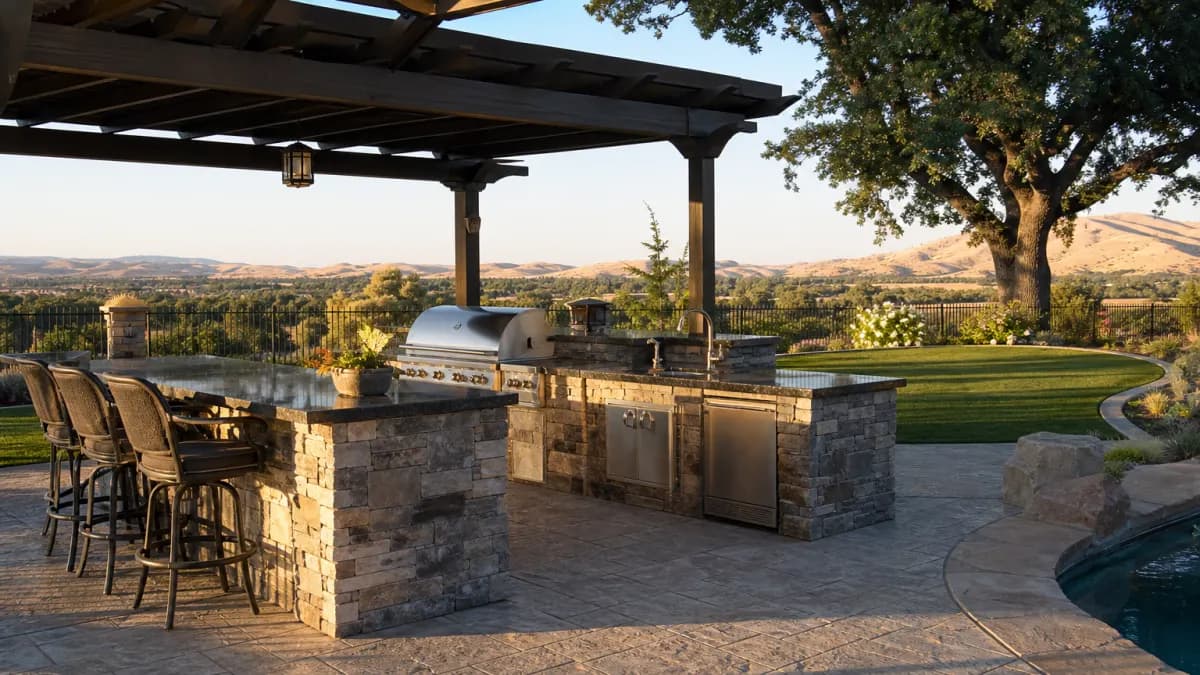
What Sacramento sun and heat do to a countertop
The National Weather Service puts Sacramento's normal July high at about 94°F, and the city averages roughly 20 or more days a year at 100°F or above. 2024 set a record with 45 triple-digit days. An uncovered outdoor counter takes that heat and direct UV for months, then winter rain. The surface has to tolerate UV without changing color and handle a hot grill lid or pan set down beside the burners.
A patio cover or pergola over the cooking area reduces sun exposure but does not eliminate it, especially on west-facing patios in late afternoon.
Materials that hold up outdoors
| Material | Outdoor suitability | Notes |
|---|---|---|
| Granite | The conventional outdoor choice | Natural stone; sealing may help with grease and stains |
| Porcelain / sintered stone | Manufacturer-rated for UV (Dekton, Caesarstone porcelain) | Heat tolerant; round the edges to reduce chipping |
| Quartzite | Natural stone, Mohs about 7 | Higher cost; confirm it is true quartzite |
| Concrete | Used outdoors | Needs sealing; can develop hairline cracks |
| Standard indoor quartz | Not warrantied for outdoor use | Choose an outdoor-rated product instead |
Why most quartz stays indoors
Engineered quartz is about 90% quartz bound with resins and pigments. Major brands exclude outdoor installs from their indoor warranties: Silestone's 25-year residential warranty does not cover outdoor use, and Caesarstone's indoor warranty excludes it. Caesarstone does sell a separate Outdoor collection with its own 10-year residential warranty. If you want the quartz look outside, ask for a product the manufacturer specifically rates for outdoor use.
Porcelain and sintered stone
Cosentino states Dekton is unaffected by ultraviolet rays and its color does not fade indoors or outdoors, and Caesarstone describes its porcelain as UV-resistant and suited to outdoor use. Thicknesses run 6, 12 or 20 mm for Caesarstone porcelain and 8, 12, 20 or 30 mm for Dekton. Thin slabs are usually mitered at the edge to look thicker.
Dark vs. light stone
Dark stone in direct afternoon sun can get uncomfortably warm to the touch. Lighter colors are a reasonable choice for an uncovered counter you will lean on.
Sealing outdoor stone
The Natural Stone Institute says it often makes sense to seal granite with a quality oleophobic sealer, which also helps with cooking oil and grease. A simple test: leave water on the stone for 10 to 15 minutes, wipe it, and let it dry. A dark spot means the stone absorbs water and is a candidate for sealing. Porcelain and sintered stone have near-zero porosity and do not need sealer. Concrete needs sealing. See granite sealing and care for the full routine.
The island base and utilities
Freestanding island bases
Most outdoor kitchens sit on a freestanding island built from concrete block, steel stud with cement board, or a prefabricated frame, then faced with stucco, stone veneer or tile. The base must be level and rigid before stone is templated, and cutouts for the grill, side burner, sink and access doors are framed first. The countertop fabricator templates on top of the finished base.
Gas, electrical and plumbing
Gas lines, GFCI outlets and any sink plumbing are separate trades and generally need permits. They should be run by licensed contractors before the stone goes on. Have the grill and appliance cutout specs ready at templating so the fabricator cuts to the exact unit.
Layout, overhangs and edges outside
Outdoor islands follow the same structural rules as indoor ones. Natural Stone Institute guidance for natural stone is a maximum unsupported overhang of about 10 in for 3cm stone and 6 in for 2cm, and never more than one third of the counter width. A bar-height seating ledge deeper than that needs corbels or steel brackets, which should be rated for outdoor exposure so they do not rust and stain the stone.
- Landing space: leave counter on both sides of the grill for trays and tools.
- Edges: rounded edges such as eased or bullnose resist chipping better than sharp corners, which matters on a counter people bump with chairs and platters.
- Drainage: a slight fall away from the house, set in the base, helps rain clear the surface.
- Seams: most outdoor islands fit on one slab, but an L-shaped island or bar may need a seam. Keep it away from the grill cutout.
Hiring for an outdoor kitchen
An outdoor kitchen involves several trades: a contractor for the base, a licensed plumber or gas contractor, an electrician, and the countertop fabricator. In California, the CSLB minor-work exemption covers only jobs under $1,000 that need no permit, so permitted utility work requires licensed contractors. Verify each license on the CSLB website. Home improvement down payments are capped at $1,000 or 10% of the contract, whichever is less.
Engineered and natural stone fabricators in California must also follow Cal/OSHA's silica rules for cutting, including wet methods or water-jet. Asking how a shop complies is a fair question.
Outdoor countertop costs
Typical national installed ranges from published cost guides. Outdoor work often adds cutouts and edge work, so get local quotes.
| Item | Typical national range |
|---|---|
| Granite | $50–$150/sq ft (exotic to $250) |
| Porcelain | $50–$120/sq ft |
| Sintered stone (Dekton-type) | $80–$200/sq ft |
| Quartzite | $65–$200/sq ft |
| Concrete | $50–$150/sq ft |
| Grill or cooktop cutout | $100–$200 each |
| Edge upgrade | $10–$40/linear ft |
These figures cover the countertop only, not the island base, appliances or utility work.
Outdoor kitchens in larger Sacramento-area lots
Larger lots in Granite Bay and El Dorado Hills have the yard space outdoor kitchens need. Check HOA rules, since exterior structures are more likely to need approval than interior work. For indoor counters, see quartz and granite countertops in Sacramento.
Main guide: quartz and granite countertops in Sacramento.