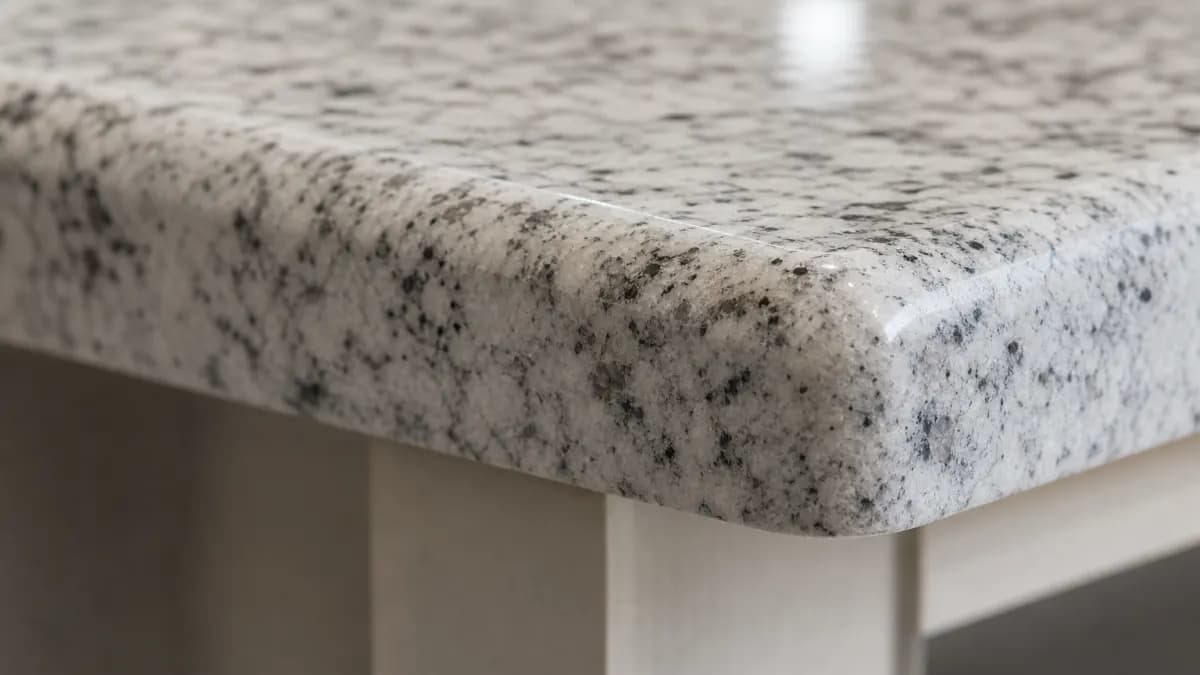
Countertop damage and the usual fix
| Problem | Common on | Usual fix |
|---|---|---|
| Edge chip | Granite, quartz, porcelain (near sinks and dishwashers) | Color-matched epoxy or resin fill, then shaped and polished |
| Open or uneven seam | Any stone | Old epoxy cut out, seam re-leveled and re-filled |
| Hairline crack | Granite, quartzite, marble | Stabilized with epoxy; supports added if it is structural |
| Etching (dull spots) | Marble, some "quartzite" | Honed and re-polished |
| Stain | Granite, marble | Poultice to draw it out, then seal |
| Scorch or discoloration | Quartz | Often permanent in quartz; sanded out in solid surface |
| Scratches | Solid surface, soapstone | Sanded and buffed out |
Cosentino notes that edges around undermount sinks and the dishwasher are common chip zones for sintered stone and that chips can be repaired; rounded edges reduce them. See countertop edge profiles.
Repair by material
Granite and quartzite
Natural stone repairs well. Chips are filled with tinted epoxy and polished flush, and dull or stained areas can be re-polished. Many granites are sealed after repair; a simple water-drop test tells you when a reseal is due. See granite sealing and care.
Quartz
Chips and seams repair the same way as granite, with resin matched to the color. Heat damage is different: a hot pan can scorch or discolor the resin in quartz, and that mark usually cannot be polished out. Use trivets.
Marble
Marble is calcite, about 3 to 4 on the Mohs scale. Acids like lemon, wine and vinegar dissolve a little of the surface and leave a dull etch. A lighter spot is usually an etch; a darker spot is usually a stain. Etches are honed and re-polished; stains are drawn out with a poultice. Sealing reduces staining but does not prevent etching.
Solid surface
Solid surface (Corian-type acrylic) is the most repairable countertop. Scratches, scorches and stains can be sanded or buffed out, and damaged sections can be cut out and replaced with an invisible seam.
Repair or replace?
Replacement usually makes more sense when:
- A crack runs through the slab and the cabinet below has sagged or shifted.
- Quartz has heat damage across a large area.
- You are changing the sink, cooktop or layout anyway.
- The top is laminate or tile, which can't be polished the way stone can.
For tops that need to go, see countertop replacement. Replacement in quartz or granite typically runs $50 to $150 per sq ft installed, plus $50 to $300 or more to remove the old top.
What to tell the fabricator
- The material and roughly when it was installed.
- Photos of the damage, with a coin for scale.
- Where it is: edge, seam, near the sink, or in the field of the top.
- Whether you have leftover pieces from the original job; they help with color matching.
Tell us about the damage and we pass it to a licensed fabricator who serves your city. For the regional overview, see quartz and granite countertops in Sacramento.
Main guide: quartz and granite countertops in Sacramento.