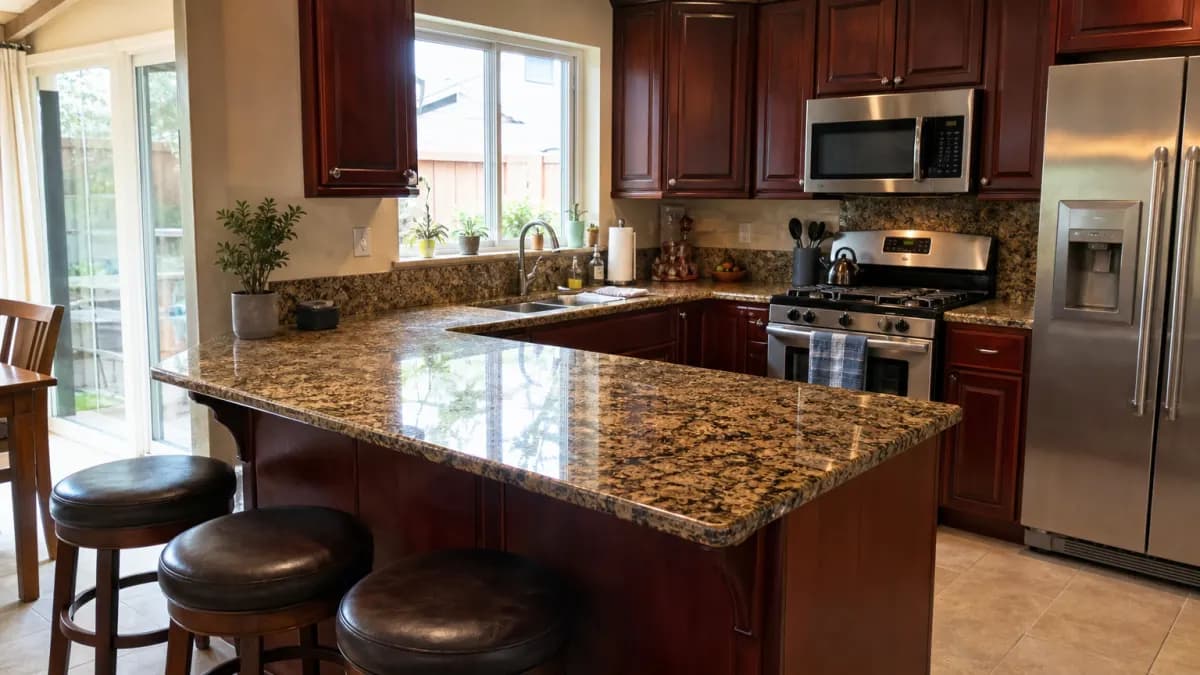
Tearing out the old countertop
What comes off determines how much work comes before the new stone goes on. Removal of the old top is typically priced at $50 to $300 or more.
Ceramic tile
Tile counters, common in 1980s and 1990s Sacramento-area tracts, sit on a mortar bed or plywood with backer board. Removing them is the dustiest and slowest tear-out, and the substrate usually comes off too, leaving bare cabinet tops. The tile backsplash often comes down with it, so plan the backsplash at the same time.
Laminate
Laminate tops are screwed up from inside the cabinets and lift off in one or two pieces. Removal is fast. Some laminate installs left a particleboard build-up strip around the cabinet top that may need removal for stone to sit flat.
Old granite
Builder-grade granite from the 2000s is glued to the cabinets with silicone. It comes off in heavy pieces and is cut or broken for removal. Undermount sinks are usually epoxied or clipped to the stone, so the old sink typically comes out with it. Decide whether you are keeping the sink before demolition day.
Cabinet condition and leveling
Stone does not flex, so cabinets must be level and solid. During templating the fabricator checks the tops for level across each run and between runs. Small differences are shimmed. Racked boxes, water-damaged sink bases or soft particleboard need repair before install. A 3cm slab of quartz runs about 639 to 675 lb per standard slab, so cabinets carrying stone need to be structurally sound.
If the cabinets themselves are being replaced, the counter template happens after the new base cabinets are installed and level.
2cm or 3cm on existing cabinets
3cm (about 1-1/4 in) is the common kitchen thickness. It sits directly on the cabinet boxes and supports overhangs up to about 10 in unsupported per Natural Stone Institute guidance. 2cm (about 3/4 in) is lighter and less expensive per square foot, but it usually gets a plywood subtop and often a laminated or mitered edge to look thicker, and its unsupported overhang guidance is about 6 in.
Thickness changes the finished counter height. Switching from tile on a mortar bed to 3cm stone can lower the surface slightly, while 2cm on a subtop lands close to 3cm. Check clearance at the range, dishwasher and any slide-in appliances.
Plumbing reconnect
Installers set the sink but do not always reconnect the faucet, drain and disposal. Ask whether that is in the contract. If not, a plumber at typical national rates of $45 to $200 per hour handles it, sometimes the same day and sometimes on a later visit. A new undermount sink and a new faucet are common add-ons with a replacement, since the old drop-in sink rarely suits stone.
Do you need a permit?
Replacing a countertop like-for-like is generally finish work that does not need a building permit on its own. Changes to plumbing, electrical, gas or walls, such as moving a sink, adding a circuit or relocating a cooktop, may trigger permits. Confirm with your city or county building department when the scope goes beyond the stone. On permitted jobs, the CSLB minor-work exemption does not apply, so any contractor must be licensed.
Replacement timeline
- Choose material and view slabs.
- Template: the fabricator measures with the old tops in place or after removal, depending on their process.
- Fabrication: typically about 1 to 3 weeks from template to install.
- Tear-out and install: often the same day for a typical kitchen; tile removal can add time.
- Plumbing reconnect and, for natural stone, sealing if needed.
Ask whether tear-out happens on install day or earlier. Removing tops early leaves you without counters during fabrication. The countertop fabrication process guide covers each step.
What can be damaged during tear-out
Removing an old top is demolition, and a few things nearby are at risk. Knowing them ahead of time avoids surprises on install day.
- Wall paint and drywall along the backsplash line, especially where a tile splash was set in mortar. Plan on patching and painting.
- Tile backsplash above a 4 in splash. It rarely survives removal of the counter below it intact.
- Cabinet face frames and top rails, if the old top was glued or screwed heavily.
- Shutoff valves and supply lines, which can leak when older fittings are disturbed.
- Flooring in front of the cabinets, from dropped pieces. Ask that it be covered.
Ask each installer who handles disposal, whether patching is included, and how they protect floors and appliances.
Replacing part of a kitchen
Sometimes only the island or one run needs replacing, after a crack or water damage. Matching an existing granite or quartz is difficult because natural stone varies slab to slab and quartz colors are discontinued. A contrasting island material sidesteps the matching problem entirely.
Replacement cost
Typical national ranges; get local quotes.
| Item | Typical national range |
|---|---|
| Quartz or granite, installed | $50–$150/sq ft |
| Average kitchen, 30–50 sq ft | $2,500–$7,500; high-end $10,000+ |
| Old top removal | $50–$300+ |
| Sink cutout | $0–$300 (first often included) |
| Plumbing reconnect | $45–$200/hr |
| Backsplash | $500–$1,500 |
Full numbers by material are in countertop cost in Sacramento.
Contracts and deposits in California
Under CSLB rules, a home improvement down payment may not exceed $1,000 or 10% of the contract price, whichever is less. You have 3 business days to cancel most home improvement contracts, or 5 if you are 65 or older. Verify any installer's license on the CSLB website before signing.
Common replacement upgrades
A common replacement path is tile or speckled granite out, quartz with an eased edge and undermount sink in. For background on the main options, see quartz and granite countertops in Sacramento. Homes in Citrus Heights and similar older neighborhoods often still have original tile.
Main guide: quartz and granite countertops in Sacramento.