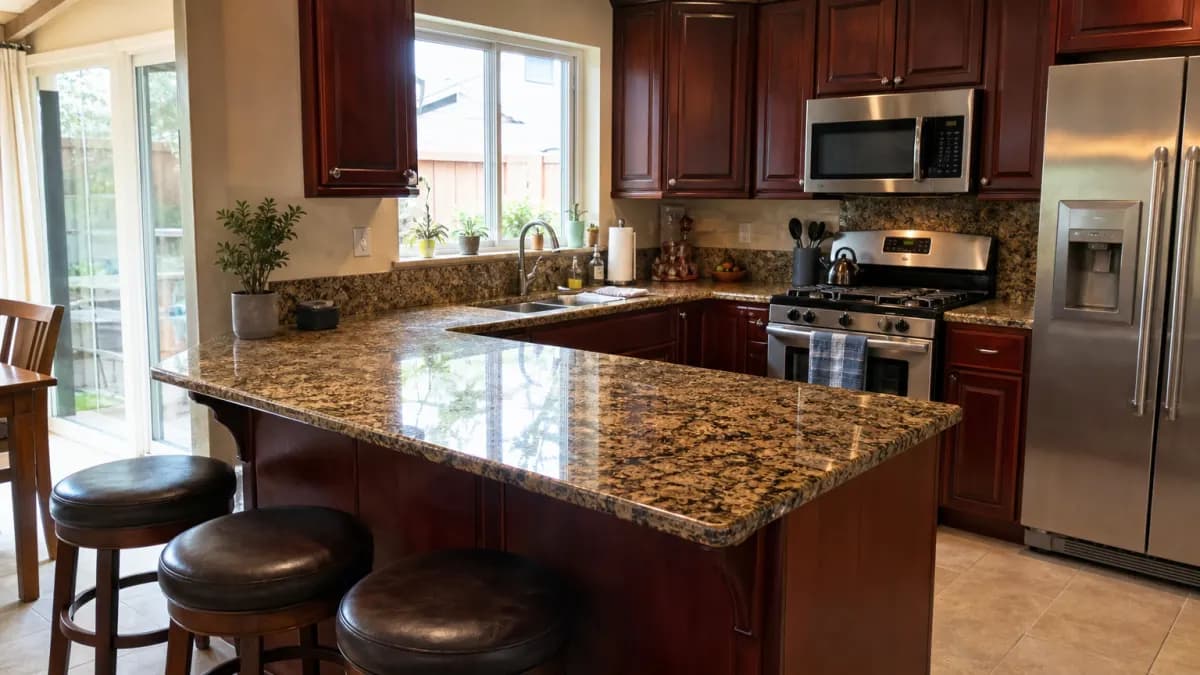
Does your granite need sealing? The water test
Not every granite needs a sealer. The Natural Stone Institute notes that many granites resist staining without one, and that sealing with a quality oleophobic (oil-repelling) sealer often makes sense for granite and marble that do absorb. The way to know is to test your own counter.
- Pick a few spots, including one near the sink and one in a high-use prep area.
- Pour a small puddle of water, about the size of a coaster, on each.
- Leave it 10-15 minutes.
- Wipe it off and let the area air-dry.
- If the stone darkened where the water sat, it absorbs liquid and is a candidate for sealing. If it looks unchanged, it does not need sealing yet.
Light-colored granite and quartzite tend to show absorption more clearly than dense dark stones, but test rather than assume.
How to seal granite and how often
Step by step
- Clean the counter with a pH-neutral stone cleaner or mild dish soap and water, then let it dry completely.
- Apply an impregnating sealer made for natural stone, following the label for coverage.
- Let it dwell for the time on the label, usually a few minutes.
- Wipe off all excess before it dries on the surface, then buff with a clean cloth.
- Keep liquids off the counter for the cure time on the label.
A sealer sits inside the stone, not on top, so it reduces how fast liquids soak in. It does not make granite stain-proof, and on marble it does not prevent etching.
How often to reseal
There is no fixed schedule. The Natural Stone Institute says a quality sealer may last 10-15 years. Many fabricators suggest resealing every year or few years, but the better rule is to repeat the water test once or twice a year and reseal when water starts darkening the stone again. Heavy-use areas around the sink wear first. Over-applying sealer does not help; excess left on the surface turns hazy.
Cleaning by material
Most daily care is the same across materials: wipe spills promptly, use a soft cloth, and stick to mild soap or a pH-neutral cleaner. The differences are in what each material cannot tolerate.
| Material | Daily cleaning | Avoid | Sealing |
|---|---|---|---|
| Quartz | Mild dish soap and water, soft cloth | Hot pans, abrasive pads, harsh solvents; follow the brand's care guide | Never |
| Granite | pH-neutral stone cleaner or mild soap | Bleach and ammonia used routinely, abrasive powders | If the water test darkens it |
| Marble | pH-neutral stone cleaner | Vinegar, lemon, citrus cleaners, wine and cola left sitting | Reduces stains; does not stop etching |
| Quartzite | pH-neutral stone cleaner | Abrasive powders; acids if the slab may be dolomite | If the water test darkens it |
| Soapstone | Mild soap and water | Cutting directly on it (it scratches easily) | Never; mineral oil optional |
| Solid surface | Mild soap or non-abrasive cleaner | Hot pans, strong solvents | Never |
| Porcelain / sintered | Mild soap and water | Impacts on edges near sinks and dishwashers | Never |
Marble: etching vs. staining
Marble is calcite, about Mohs 3.5, and reacts with acids. A lighter, dull spot is usually an etch, where acid dissolved a little of the polish. A darker spot is usually a stain. Sealing helps with stains only. Wipe up wine, citrus and tomato quickly. See marble countertops.
Soapstone and mineral oil
Soapstone is near-zero porosity and highly resistant to acids, so it needs no sealer. Wiping it with mineral oil is optional and darkens the stone evenly while the natural patina develops. Scratches can be sanded out lightly. See soapstone countertops.
Solid surface repairs
Corian-type solid surface is acrylic and minerals. Light scratches, scorches and stains can be sanded or buffed out, which is its main advantage over stone. See solid surface countertops.
Removing common stains from granite
Oil stains on absorbent granite or marble are usually darker spots. A poultice of baking soda and water, left covered for a day and then removed, can draw some out. Water rings on stone often fade as the stone dries. Test any stain remover in a hidden spot first, and for etched or stubborn stains on marble or valuable stone, call a stone restoration professional rather than experimenting.
Quartz stains are rare because it is non-porous. Most marks are on the surface and come off with mild soap or the cleaner the manufacturer recommends. Compare the materials' upkeep in types of countertops.
Heat: trivets for quartz and solid surface
Caesarstone describes quartz as heat resistant but not heat proof; the resin can be permanently marked by a hot pan. Solid surface can scorch too. Use trivets or hot pads for pans straight off the burner or out of the oven, and for slow cookers and air fryers that sit in one spot for hours. Granite and quartzite tolerate heat better, but a trivet still protects seams and finishes. More on how materials compare in quartz vs. granite.
Cold-to-hot shock is another reason for trivets. A pan straight from a hot oven onto a cool stone can stress the slab near seams and cutouts, where the stone is narrowest.
Hard-water spots around the faucet
If your water leaves white mineral rings around the faucet and sink, dry the area after use and wipe with a damp microfiber cloth. On granite, quartz and quartzite, a product labeled safe for that stone can lift buildup. On marble and other calcite stone, skip vinegar and lime-scale removers, which etch the surface. A water softener or filter reduces spotting at the source.
Common mistakes that damage countertops
- Standing on counters to reach upper cabinets. Overhangs and seams are not designed for a person's weight.
- Cutting directly on stone or quartz. It dulls knives and can scratch softer stone like marble and soapstone.
- Leaving a slow cooker or electric griddle on quartz without a trivet.
- Using magic erasers or scouring powder on polished finishes, which can dull them over time.
- Letting oil, wine or coffee sit overnight on unsealed light granite or marble.
- Applying sealer to quartz, porcelain or soapstone. It has nowhere to go and leaves a film.
When to call a professional
Deep etching on marble, chips at sink edges, cracked or separated seams and stains that do not lift are jobs for a stone restoration specialist or fabricator. Porcelain chips near undermount sinks and dishwashers can often be repaired. If the top is beyond repair, see countertop replacement. We connect you with licensed local fabricators; start at quartz and granite countertops in Sacramento or contact us.
Main guide: quartz and granite countertops in Sacramento.