The common edge profiles
Caesarstone lists eased, pencil, bevel, bullnose, ogee, miter and radius profiles for its quartz. Fabricators use similar names for natural stone, though exact availability varies by shop and by the machine they run.
Eased edge
A square edge with the top and bottom corners lightly rounded. It is the default modern look and is usually included in the base price. An eased edge reads clean on quartz and on thick slabs, and suits shaker and flat-panel cabinets.
Pencil and radius edges
A pencil edge has a slightly larger rounding on the corners than eased. A radius edge rounds the top corner further. Both soften the look without the full curve of a bullnose and are often priced like eased or as a small upgrade.
Bevel
A flat 45° cut along the top corner, typically about 1/4 to 3/8 in wide. It catches light and adds a little detail to a plain slab.
Half and full bullnose
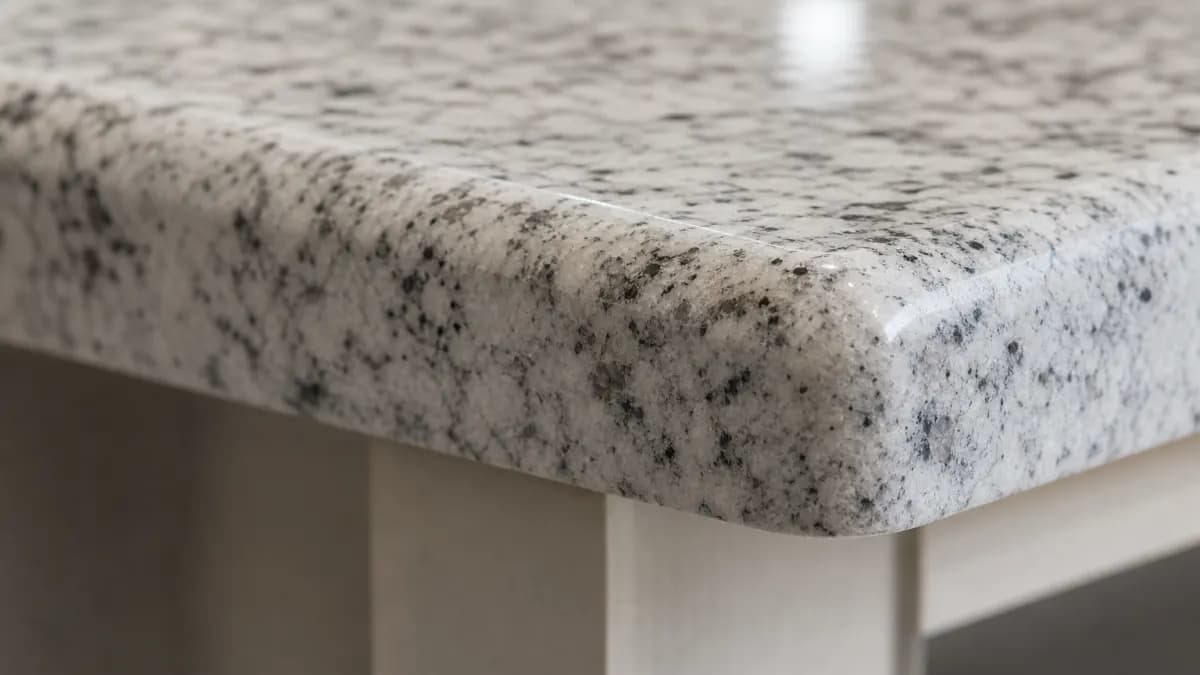
A half bullnose rounds the top into a curve and leaves the bottom square. A full bullnose rounds both top and bottom into a continuous half circle. Full bullnose was common on 2000s builder granite. It is friendly to hips and kids but lets spills drip off the edge onto cabinet fronts.
Ogee and dupont
An ogee is an S-shaped curve, the classic traditional profile. A dupont steps down at the top then rounds at the bottom. Both suit traditional kitchens and take more machine time, which is why they cost more.
Edge cost per linear foot
Published cost guides give these typical national ranges. Edges are priced per linear foot of exposed edge, not per square foot of counter, so an island with three open sides costs more to upgrade than a wall run.
| Edge | Typical national cost |
|---|---|
| Eased / straight | Usually included |
| Bevel | $10–$15/linear ft |
| Half bullnose | $10–$15/linear ft |
| Full bullnose | $10–$15/linear ft |
| Ogee | $20–$25/linear ft |
| Dupont | $20–$40/linear ft |
| Mitered | Quoted per linear ft or per job; varies |
| Waterfall end | $500–$2,000 per end |
As a sense of scale: a kitchen with about 30 linear ft of exposed edge at $20 per foot adds about $600. See countertop cost in Sacramento for full project numbers.
Mitered edges
A mitered edge joins a strip of the same stone to the countertop at 45°, so the counter looks thicker, often 2 in or more, with the pattern wrapping over the edge. It is how thin porcelain and 2cm stone get a substantial look. A good miter on veined stone continues the veining around the corner. Pricing varies widely by shop and is quoted per linear foot or per job, so get it itemized.
Waterfall edges
A waterfall carries the countertop down the side of an island to the floor, mitered at the top corner so the pattern flows from top to side. Published guides put a waterfall at $500 to $2,000 per end, including material and install. Each end uses a full-height piece of slab, so a double waterfall may push an island onto an extra slab. Veined materials like quartzite and veined quartz are the usual choices.
Chip resistance by edge
Sharp corners chip; rounded ones shed impact. Cosentino recommends rounding edges on Dekton to minimize chipping and notes that chips most often happen near undermount sinks and the dishwasher. The same logic applies to quartz and natural stone.
- Most chip resistant: full bullnose, half bullnose, radius.
- Good: eased and pencil, since the corners are softened.
- More vulnerable: sharp square edges, thin bevels, and the outer point of a mitered edge.
Hardness matters too. Granite (Mohs 6 to 7) and quartzite (about 7) handle knocks better than marble (about 3.5) or soapstone (1 to 4), which can dent or chip at an edge.
Edge thickness: 2cm, 3cm and laminated edges
Slab thickness sets the starting height of every edge. 3cm (about 1-1/4 in) gives a substantial edge on its own and takes any profile. 2cm (about 3/4 in) looks thin on a kitchen counter, so fabricators commonly build it up with a laminated edge, a second strip bonded underneath, or a mitered edge, to reach about 1-1/2 in or more. Caesarstone lists its quartz profiles in depths from 20 mm up to 40 mm and beyond.
Porcelain and sintered stone are thinner still: Caesarstone porcelain comes in 6, 12 or 20 mm and Dekton in 8, 12, 20 or 30 mm. Thin porcelain is almost always mitered at exposed edges. Some porcelain slabs have a printed surface pattern that does not run through the body, so a rounded profile can expose a different color underneath. Ask what edges the fabricator recommends for the specific product.
Edges around sinks and corners
The edge you pick for the counter front is not the only edge on the job. An undermount sink cutout gets its own polished edge, and Cosentino identifies the area around undermount sinks as a common chip zone, so a slightly rounded cutout edge helps. Outside corners can be left square, eased or radiused. A radiused corner on an island is gentler on hips and less likely to chip. Published guides list corner and curve work at about $50 to $150 each where it is charged separately.
Matching edge to material and style
Modern kitchens with quartz countertops usually take an eased or mitered edge. Traditional kitchens in granite or marble suit ogee or bullnose. Porcelain with a printed surface may not suit profiles that expose its body, so ask the fabricator which edges they recommend for that product. For the full material picture, start at quartz and granite countertops in Sacramento.
Edges in Sacramento remodels
Builder granite from the 2000s, common in suburbs such as Roseville, often came with a full-bullnose or ogee edge. Replacing it with an eased edge is one of the quickest ways to make a kitchen look current. More on that job in countertop replacement.
Main guide: quartz and granite countertops in Sacramento.